All Big Data is equal, but some Big Data may be more equal than others

alexlanc's avatarBiosystems Analytics

We are in the era of Big Data in human genomics: a vast treasure-trove of information on human genetic variation either is or will soon be available.   This includes older projects such as the HapMap, and 1000 Genomes to the in-progress 100,000 Genomes UK.  Two technologies have made this possible: the advent of massively parallel “next generation” sequencing where each individuals’ DNA is fragmented and amplified into billions of pieces; and powerful computational algorithms that use these fragments (or “reads”) to identify all the “variants” – any changes that are different to the “reference genome” – in each individual.

With existing tools this has become a relatively straightforward task.  Identification of single nucleotide polymorphisms or variants (SNVs) – single base differences between the individual and the reference genome – especially medically relevant ones –  is beginning to become routine. A project I worked on with…

View original post 780 more words
“It’s Time”: remembering modems, BBS, Telecom, Gough and The Dismissal in Peter Carey’s Amnesia

Author Peter Carey, one of Australia’s best known literary exports (he has lived in New York City for the past 20 years) is probably most identified with novels such as The True History of the Kelly Gang, Illywhacker, and Oscar and Lucinda which all draw heavily on Australian history and mythology of the late 19th and early 20th centuries.  Oscar and Lucinda  was also made into 1997 film film of the same name featuring Ralph Fiennes and Cate Blanchette.  Despite this reputation, Carey has written novels that deal with more contemporary life, including the darkly comic Bliss, in which bored advertising executive, Harry Joy, is briefly clinically dead, but upon returning to life, finds himself in a reality that may, or may not, be a version of hell.   (Bliss was also made into a highly underrated film, with the peerless Barry Otto as Joy).  Carey’s most recent effort, Amnesia, delves into the very present day concerns of technology and surveillance.  Largely split between a present-day “thriller” narrative and a slightly disheveled and cut-up history of both 1950s and 1980s Melbourne life as seen through the lens of politically active family, Amnesia fuses Carey’s brilliant use of language, with more overt political undertones.

Read More »

Finding data in the long-tail

alexlanc's avatarBiosystems Analytics

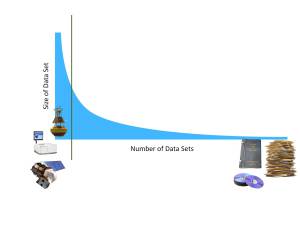
blog_1_fig_1Scientists are increasingly examining the most comprehensive catalogue of datasets for any particular question.  Making sure you can find as much of the data relevant to a particular problem thus begins to loom as a large issue.   Although institutional repositories (such as NCBI, Dryad, Figshare etc.) are great at storing the final published versions of the data sets, some early and smaller-scale research data can get lost in the “long-tail“.   Anne Thessen has a great post over on her blog on the Data Detektiv, on how to locate and keep track of such “dark data”:

Finding relevant data, especially if the needed data are dark, can be a difficult and lengthy task. … Was there a way to discover data based on events earlier in the research workflow? After some thought, I realized that databases and lists of awards made by funding agencies were an…

View original post 21 more words

“Hey Peter, I’m gonna need you to come in all the time. Does all the time work for you?”

Fans of the 1999 movie Office Space will have surely noticed the recent front page above-the-fold article in last Sunday’s New York Times on working conditions at Amazon has stirred up a lot of interest, including a response from Jeff Bezos himself (who states, somewhat incongruously, that he has “zero tolerance for lack of empathy”).   One of the reasons that this article gained so much traction (as opposed to the steady drip-drip of articles about work conditions at it’s warehouses), is that it focused on the changing work environment of many upper-middle-class white-collar workers all over the country (which is, let’s face it, the readership of the New York Times).   The rise of the 24/7 work culture, constant e-mail, tethering to our smartphones, and now the micro-surveillance of work “productivity” has now passed some kind of rubicon, where more and more people are increasingly asking, like the Peter Gibbons character in the film: what’s the whole point of it?

Read More »

Volvocine algae relationship status: “It’s complicated”

alexlanc's avatarBiosystems Analytics

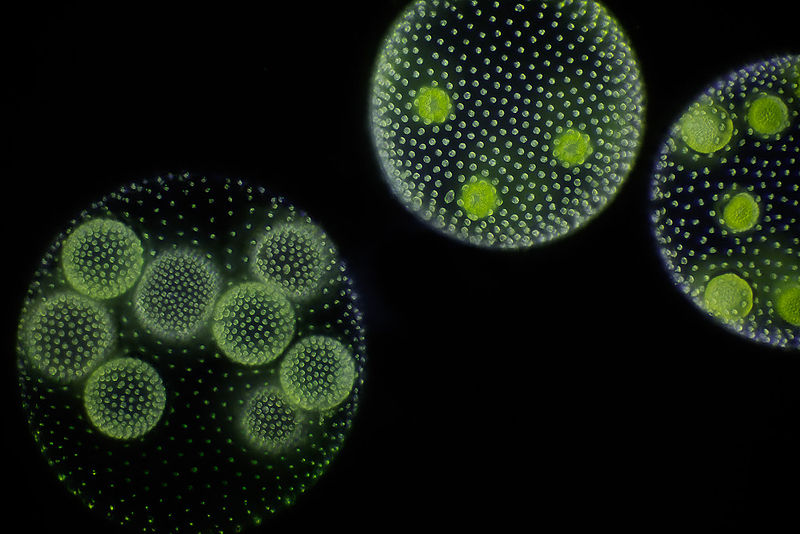
800px-Mikrofoto.de-volvox-4Volvox are green algae that can form large and amazingly beautiful colonies of up to 50,000 cells, and have been widely studied as a model for the evolution of multicellularity, but they also have a huge diversity of mating systems.   Matthew Herron has a great post over on his blog, Fierce Roller (which focuses on the the biology of volvocine algae and evolutionary mathematical models amongst other things), about the unusual and complicated world of Volvox sex, direct from the the Volvox 2015 conference.   For those of us who work mostly on model organisms, it’s good to be reminded that these organisms are just the tip of the proverbial evolutionary iceberg, and that there are many great practical and conceptual discoveries awaiting all over the tree of life.

Volvox, and the volvocine algae in general, are well known as a model system for the evolution of multicellularity and cellular…

View original post 158 more words

The Newsroom, unicorns and the Sorkin view of the world

The-NewsroomAaron Sorkin’s cable news drama The Newsroom wrapped up it’s third, and final season at the end of last year on HBO.  As pure piece of entertainment it’s fun to watch, especially with a great cast and the pyrotechnic dialog for which Sorkin is a specialist, but as a commentary on the current state of news, it has some serious flaws, that bothered me enough to write them down.  What’s that, you’ve never heard of The Newsroom?  Well, allow me a brief recap: Jeff Daniels plays Will McAvoy, a cable news anchor of the Dan Rather/Tom Brokaw/Peter Jennings vintage on the fictional Atlantis Cable News (ACN) network (a sly dig at Atlanta-based CNN, no doubt).  The series opens in the Q&A portion of a panel discussion on a university campus featuring McAvoy, when a college student asks a particularly naive question: “Can you say why America is the greatest country in the world?”.  After a few attempts to avoid answering this directly (clearly he disagrees with the premise of the question), McAvoy decides enough is enough and starts channelling his inner Howard Beale (the fictional TV newscaster from the 1976 film Network who extorted  his audience to open their windows and yell: “I’m as mad as hell, and I’m not taking it anymore”).  McAvoy’s response is worth reading in detail, it’s pure Sorkin, the kind of thing that we all wish important people would say, but never do.Read More »